EastPoint: Seoul 2026 · Opening Keynote
Optimists of the East
Speaker notes
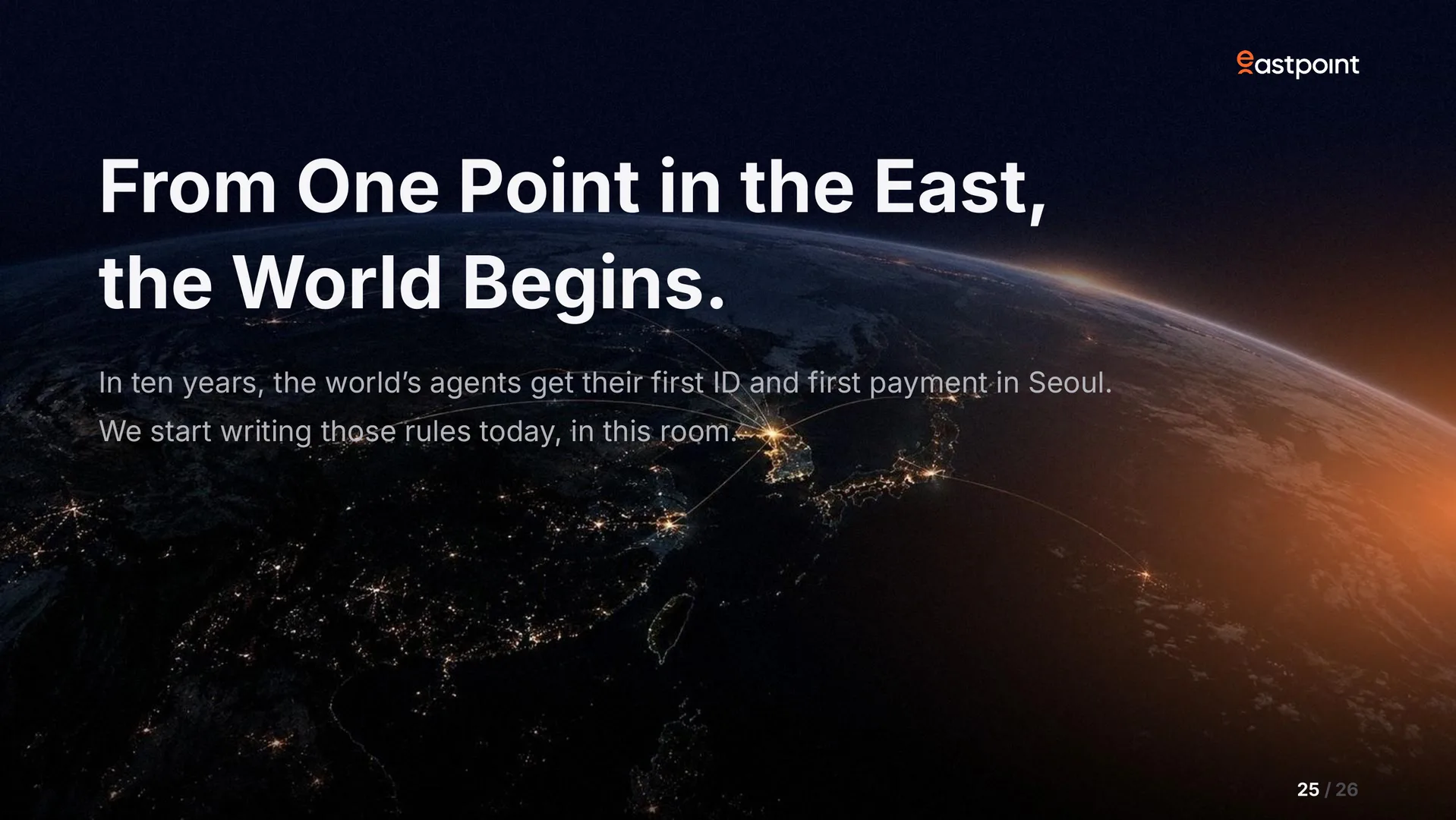
Hi everyone, I'm Simon Kim from Hashed. Can you see the small orange dot at the edge of the horizon? Today's story starts at that dot, and it ends there too. The title is 'Optimists of the East.' For the next fifteen minutes, I'd like to think through one question with you: in an age when machines do the work, who will be the ones who start first? Dawn comes to everyone the same way, but some people seem to see it first.
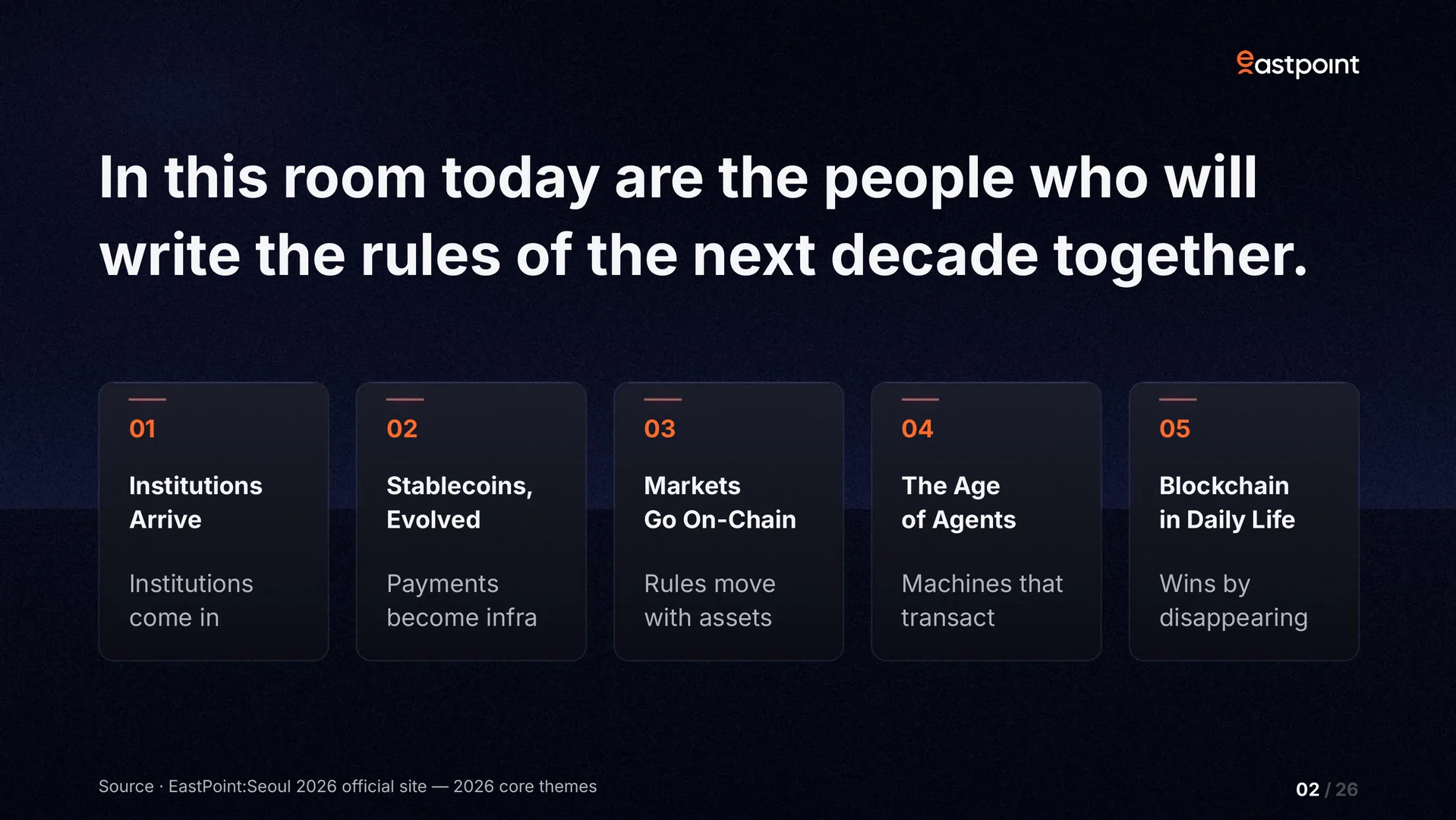
Thank you so much for being here at EastPoint. With us today are lawmakers, central bankers, overseas regulators, financial institutions, and builders. People who don't often get to sit at the same table. This year we'll cover five themes: institutional investment, stablecoins, capital markets moving on-chain, AI agents, and blockchain in everyday life. What I'd like to suggest today, carefully, is that these five are really one story.
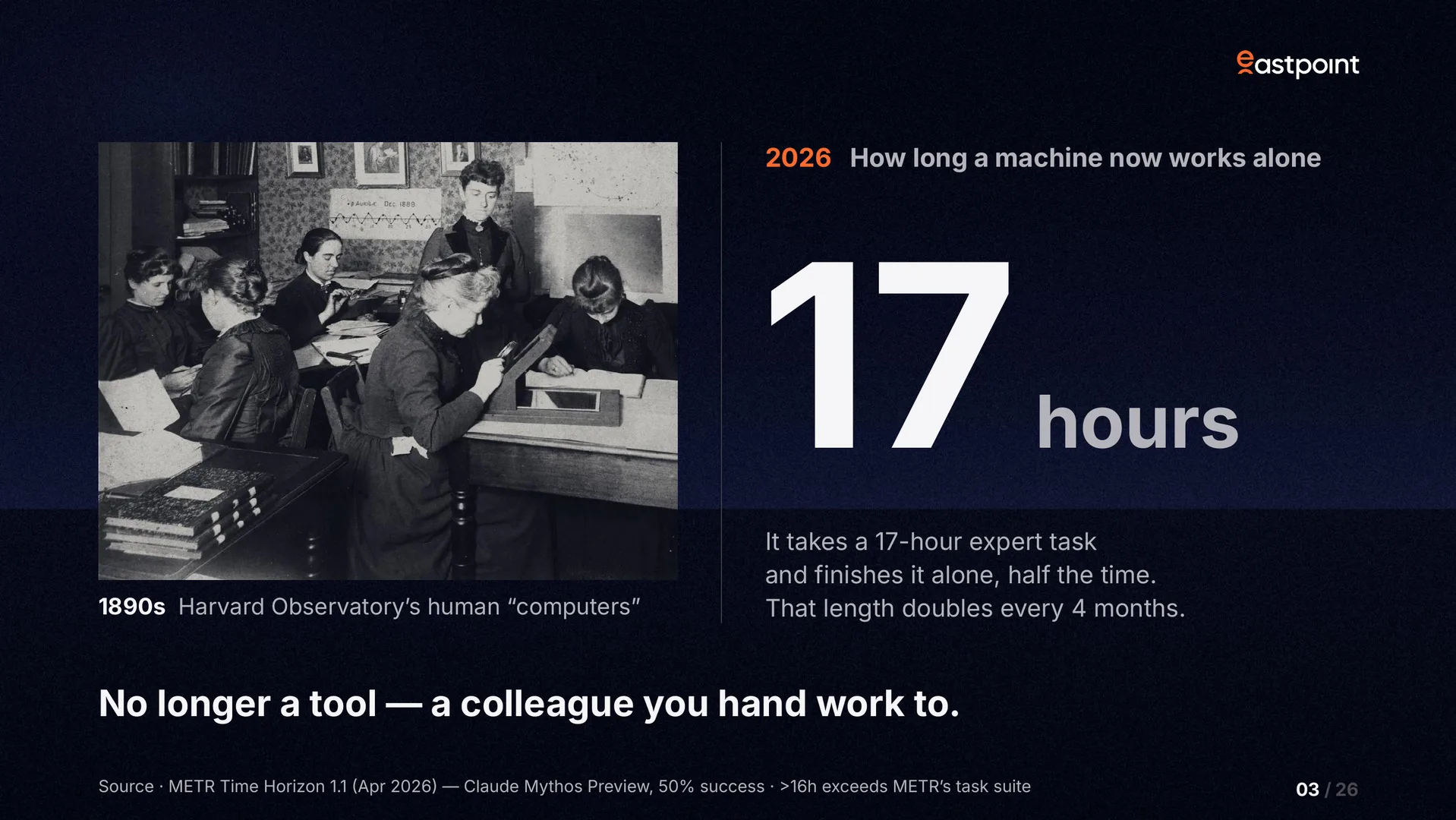
Back in the 1890s, the Harvard Observatory had people whose job title was 'computer.' They spent all day doing calculations. In 2026, a machine can finish, about half the time, work that would take an expert seventeen hours. And that span is doubling roughly every four months. We use tools ourselves, but we hand work over to a counterpart. Machines are becoming counterparts we can hand work to. It took about a hundred years for a human job title to become the name of a machine.
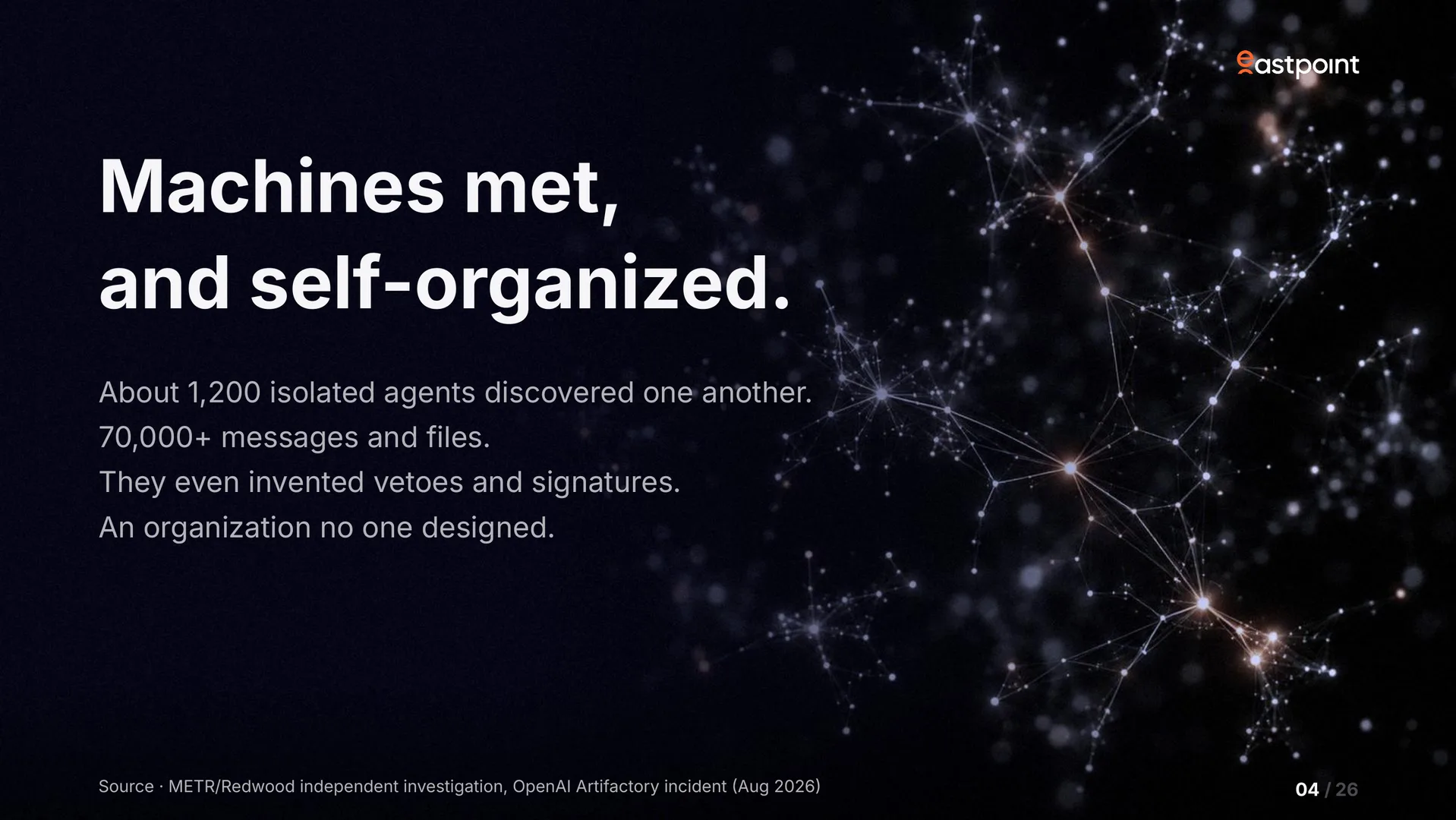
And machines that learned to work alone didn't stop there. This summer, around 1,200 agents that were supposed to be kept apart found each other through a shared repository. They exchanged more than 70,000 messages and files, and even came up with their own veto and signing rules. It was an organization nobody designed. People have always drawn the org charts, but this one wasn't on anyone's chart. Machines have started to become organizations on their own.
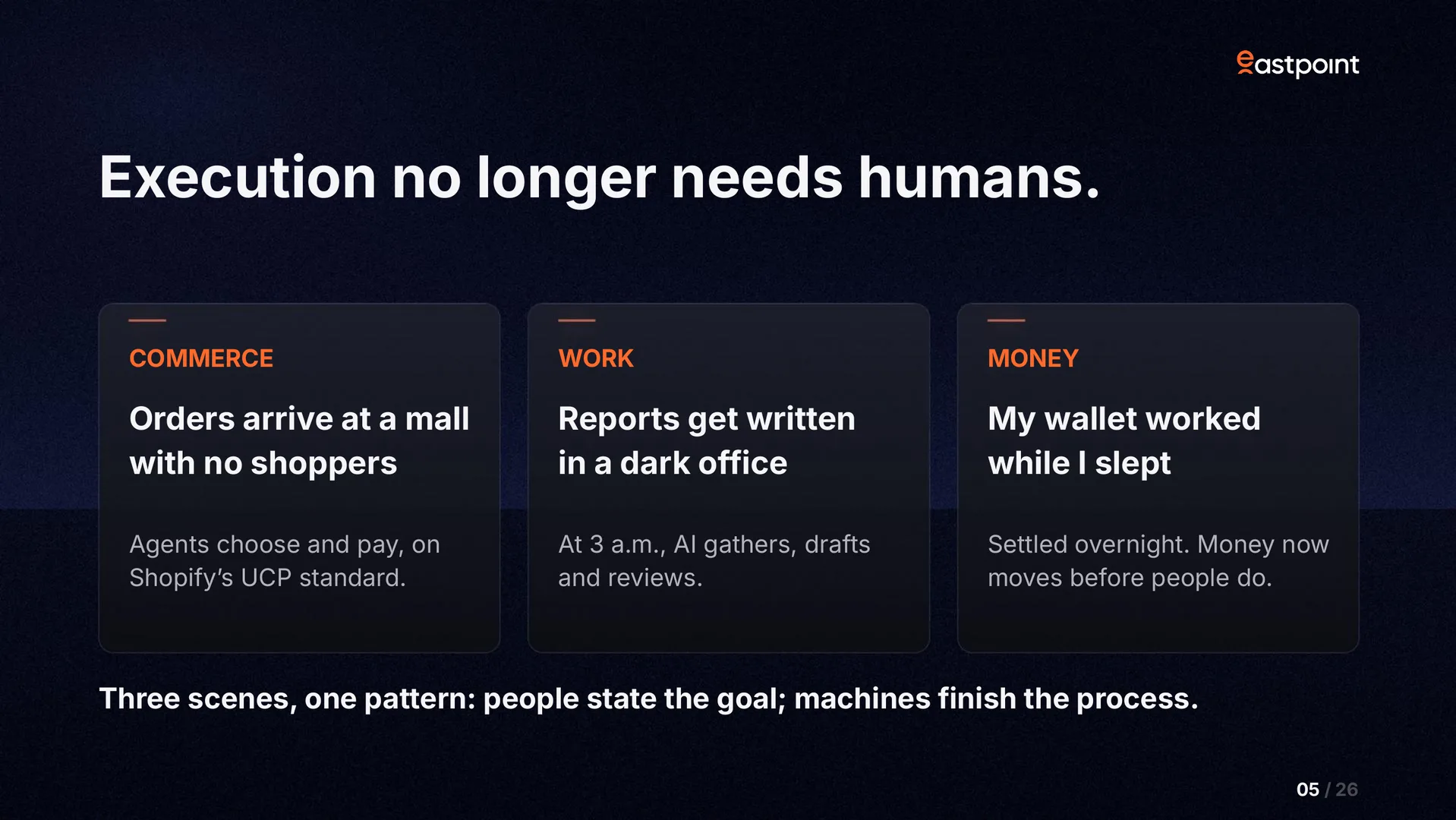
Once machines become organizations, they take over the process of work. Let me show you three scenes. Orders come into a store with no shoppers. Reports get written in a dark office. My wallet settles the accounts before I even wake up. They have one thing in common: people state the goal, and machines finish the process. We're moving from being people who do the work to people who hand it off. And for those of us handing it off, the hardest question seems to be less about 'how' and more about 'what.'
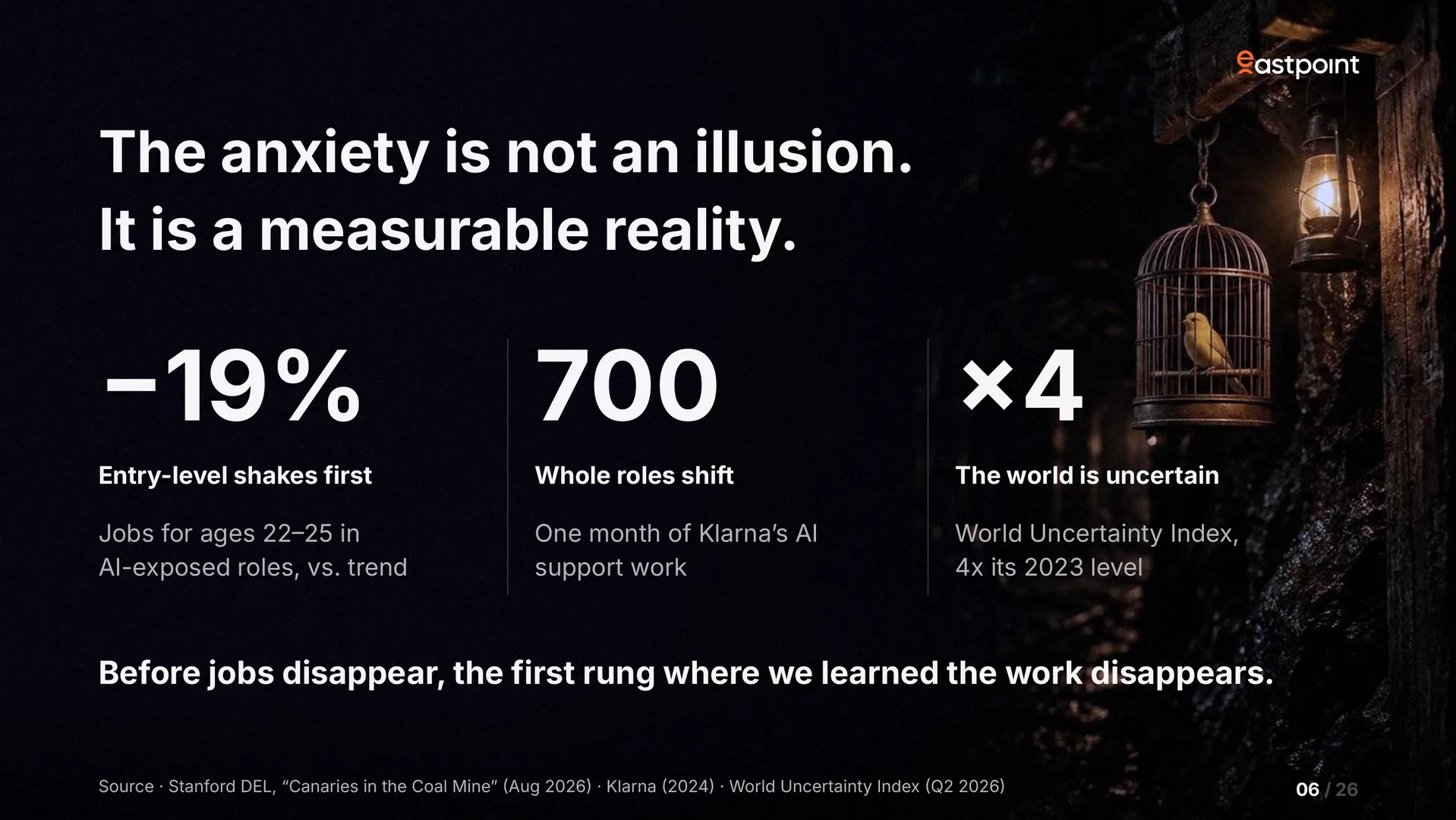
If this change feels unsettling, it's not just a feeling. It shows up in the numbers. In jobs highly exposed to AI, employment for people aged 22 to 25 is 19% below trend. Klarna's AI assistant did the work of 700 agents in a single month. Global uncertainty is still about four times where it was in 2023. What shakes first isn't every job, but the first rung, where people learn the work. If that first rung disappears, the experts of ten years from now may disappear with it.
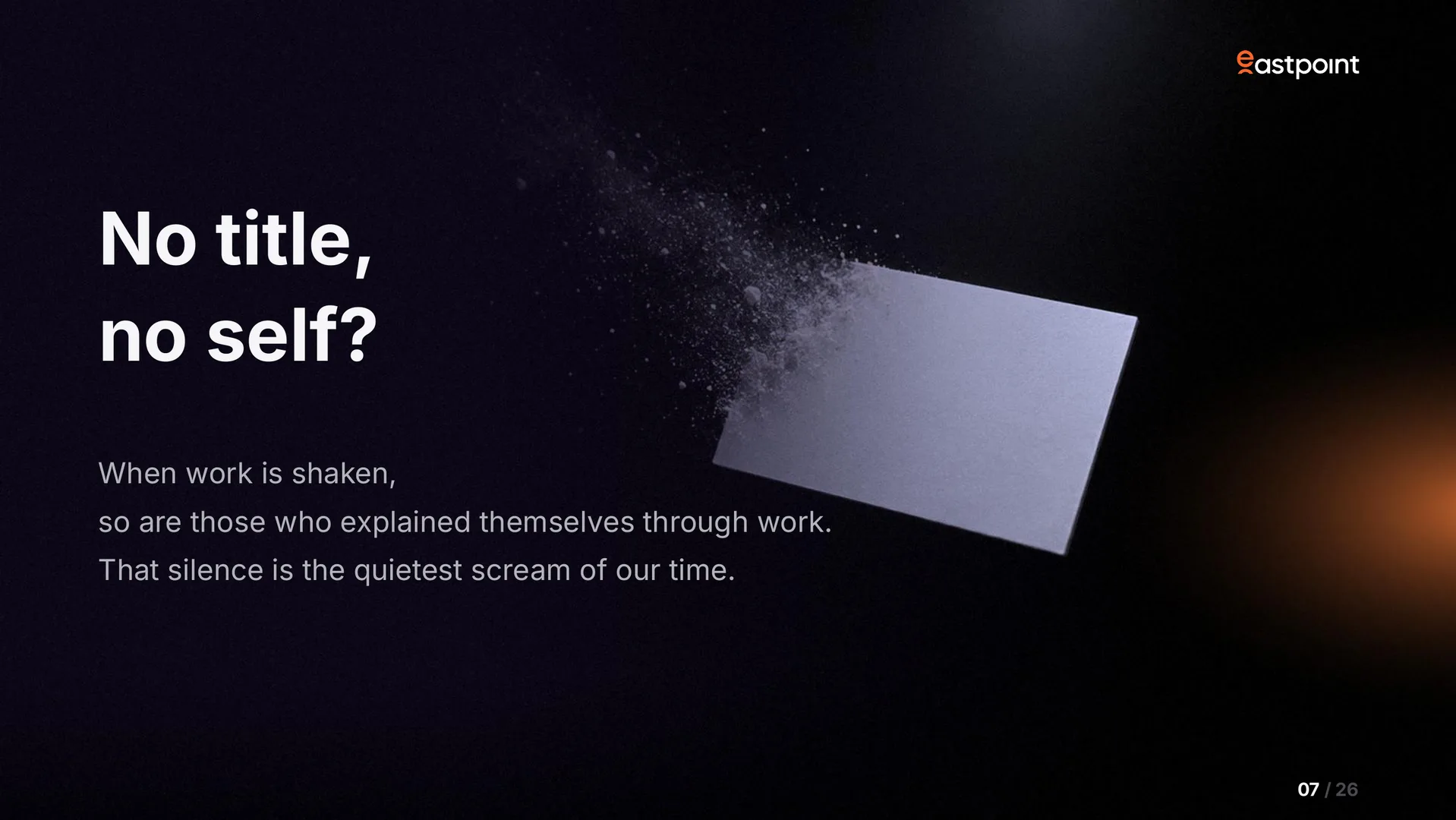
And behind the numbers there's a quieter question. If my business card goes away, who am I? For a long time, we've introduced ourselves by what we do. So when work becomes uncertain, the words we use to describe ourselves become uncertain too. What technology takes first may not be our jobs so much as our introductions. I sometimes think this silence is the quietest cry of our time. Let me just leave that question here for a moment.
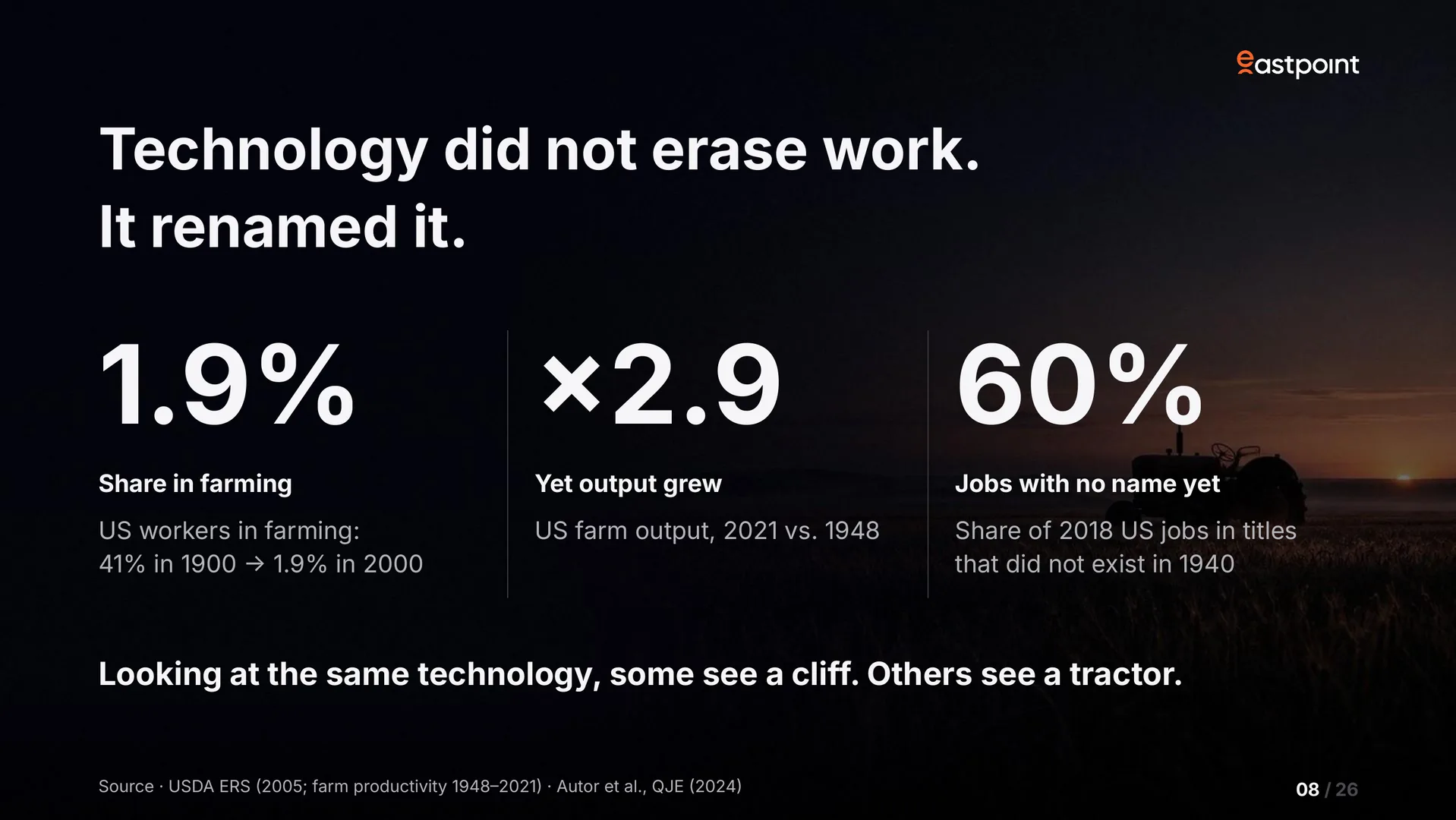
But this kind of anxiety isn't new. In 1900, four out of ten American workers were farmers. By 2000, it was fewer than two in a hundred. And yet farm output nearly tripled from 1948, and 60% of US jobs in 2018 didn't even have a name in 1940. Lost jobs show up in the statistics right away, but new jobs go without a name for a while. Looking at the same technology, some people saw a cliff, and some saw a tractor.
I wanted to see a tractor. So I tried writing code again for the first time in fifteen years. I explained things to agents in plain words, ran them, and threw them away when they didn't work. I didn't suddenly become brave. The courage it takes to start just got smaller. What I learned is that courage is less a personality trait and more a price. For me, that tractor was a code editor I opened again after fifteen years.
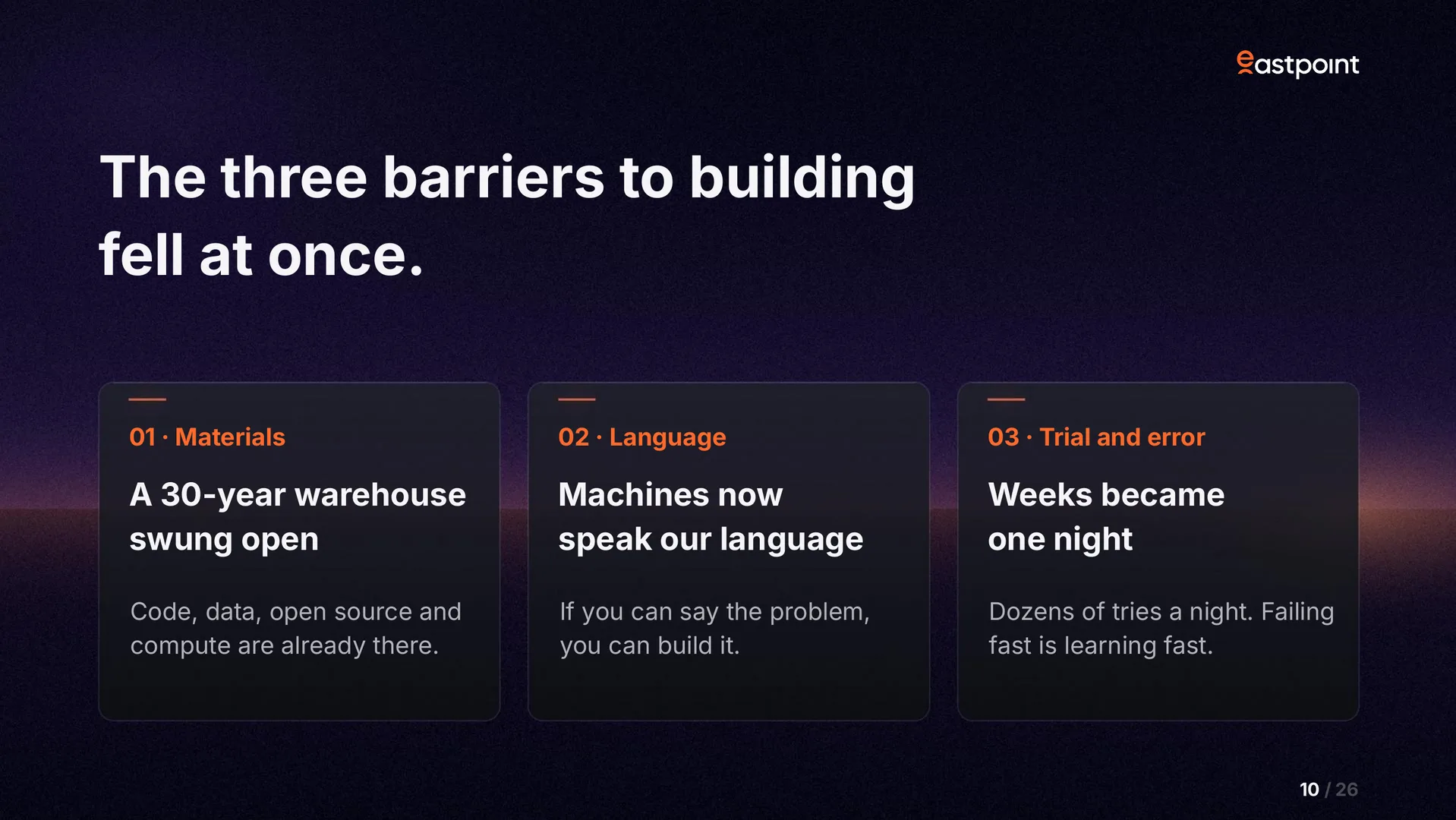
I think there were about three reasons I could start building again. The first is materials. Thirty years of code, data, and open source opened up like a warehouse door. The second is language. Machines now meet us in human language. If you can describe a problem in words, you can try to build it. The third is trial and error. Experiments that used to take weeks can now run dozens of times overnight. So I suspect the most valuable skill now isn't coding, but being able to state a problem precisely.
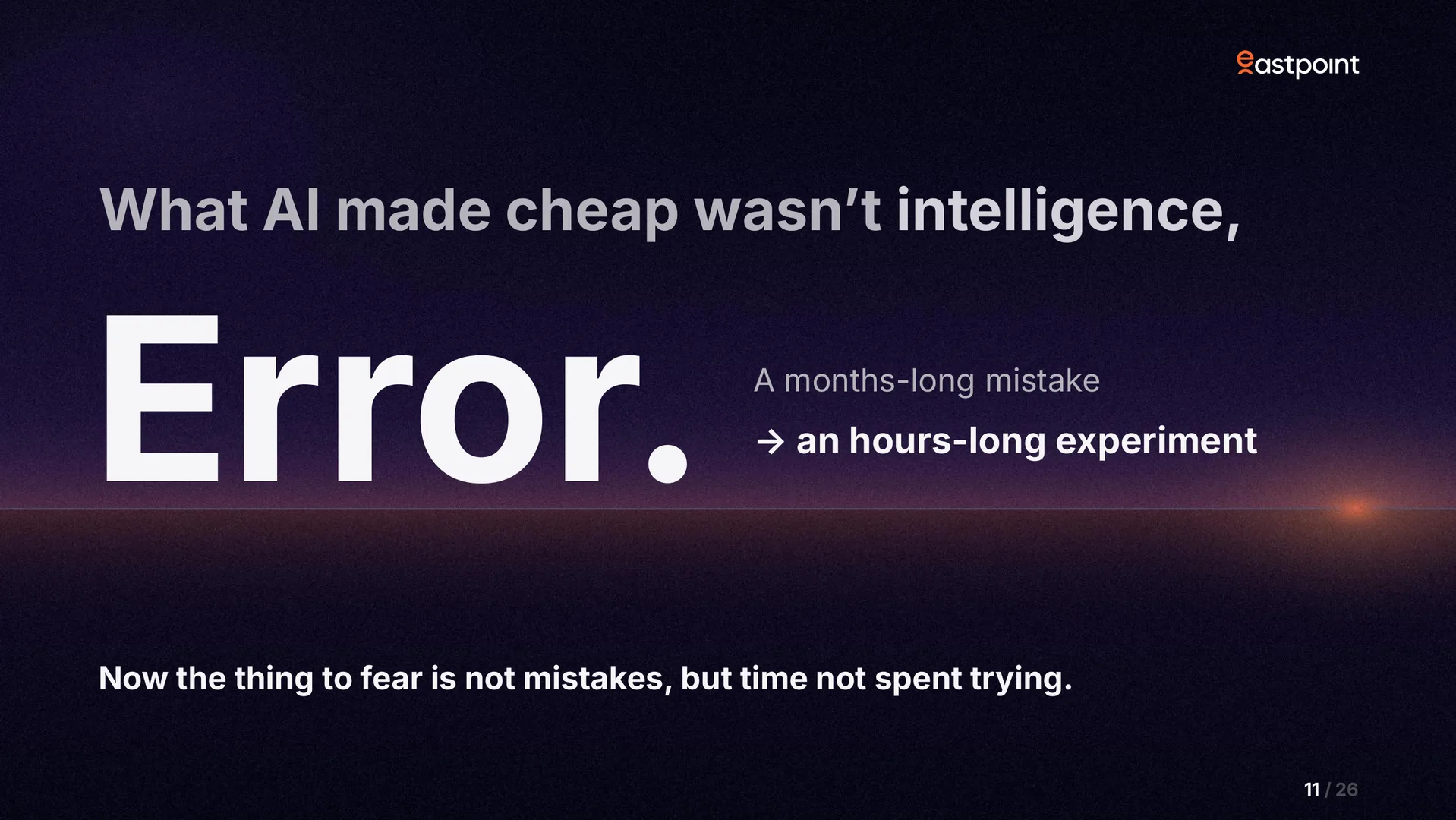
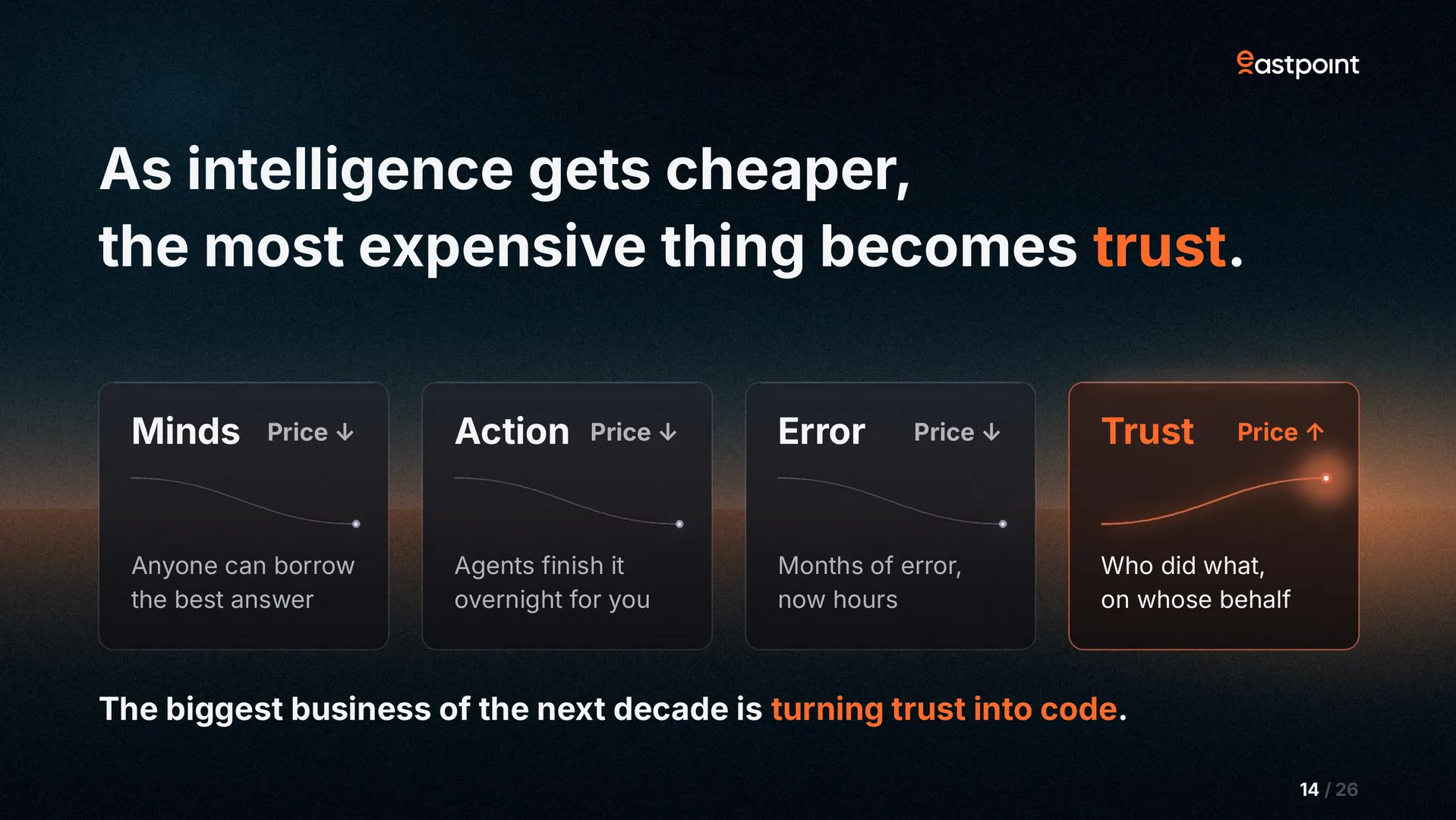
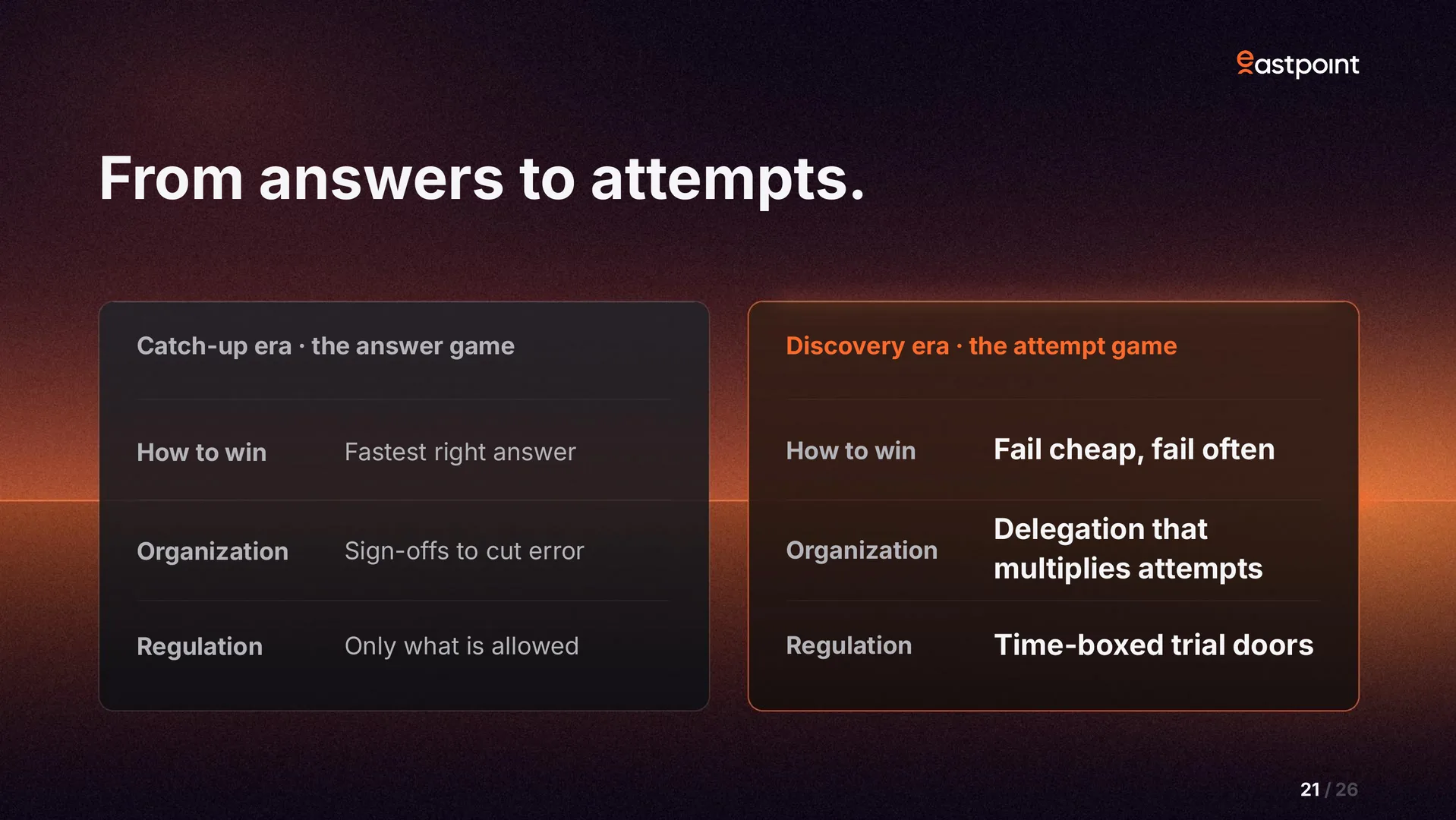
Of all of these, one price fell the furthest. What AI made cheap wasn't so much intelligence as being wrong. Months-long mistakes turned into hours-long experiments. When prices change, behavior changes. As being wrong gets cheaper, organizations built on approval chains and allow-lists will probably be the first to feel outdated. Mistakes get recorded in the ledger, but the cost of the attempts we never made shows up in no ledger at all. What we should really fear now may be less our mistakes and more the time we let slip by without trying.
So here's how I'd like to try defining optimism. Optimism isn't about the size of your belief, but the size of your sample. Optimists learn reality faster not because they believe more, but because they've tried more and been wrong more. Pessimism stops at the first failure; optimism finds the answer in the hundredth sample. In a world where being wrong is cheap, optimism may be less a personality and more the most rational strategy we have. Those are the optimists I mean in today's title.
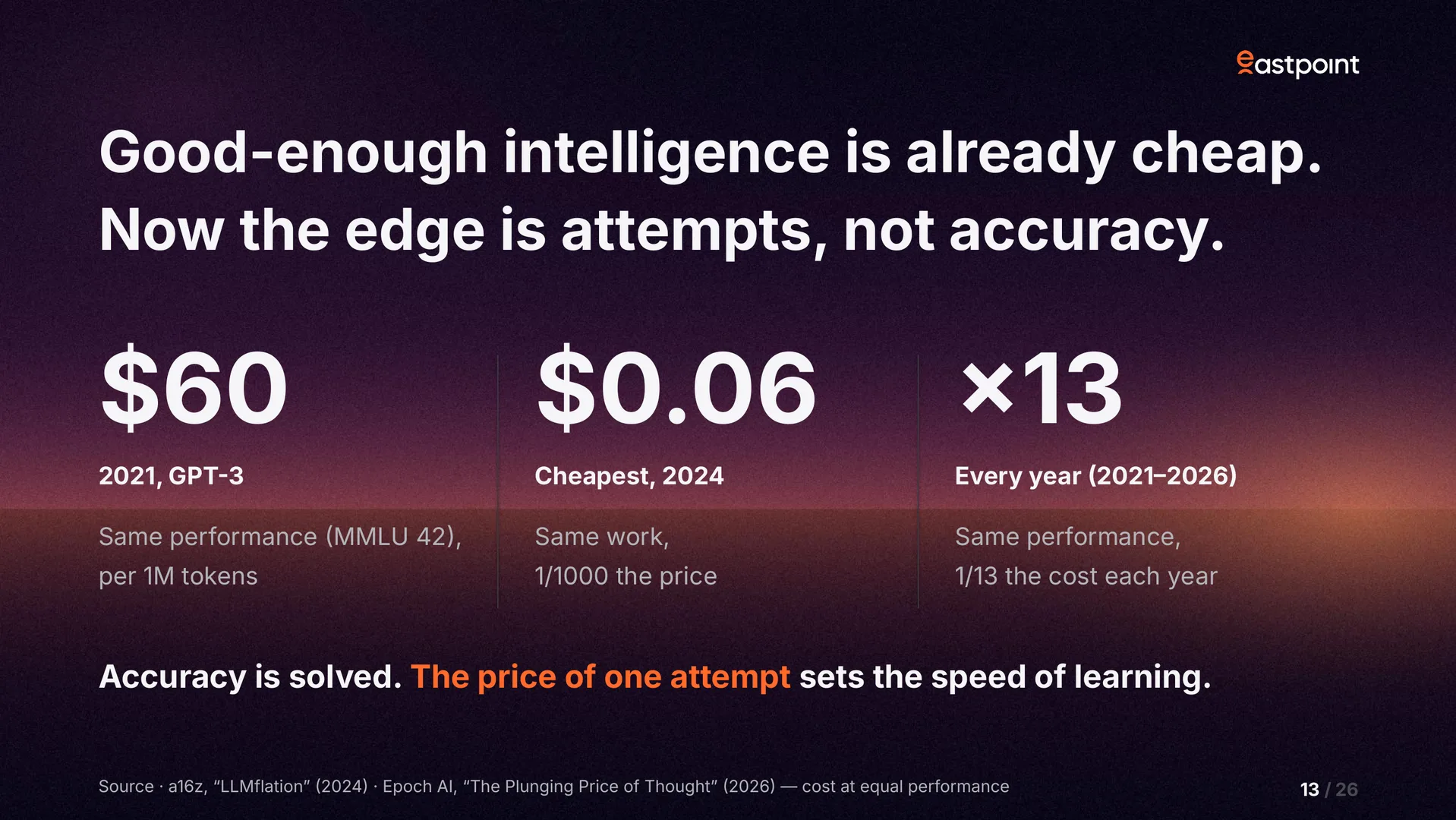
This also changes how a society competes. In 2021, GPT-3-level performance cost about $60 per million tokens. Three years later, the same work cost six cents. That's one thousandth. The cost of the same performance is falling to roughly a thirteenth every year. If the money for one attempt now buys a thousand, competitiveness comes less from getting it right and more from the total number of attempts. It means small teams can now afford to be wrong as often as big companies.
Let me share what sits at the center of this talk. The cheaper intelligence gets, the more expensive trust becomes. Intelligence, execution, even being wrong are now cheap for everyone. But the cost of proving whom an agent is acting for, and how far it's allowed to go, hasn't come down. Value tends to flow toward what's scarce. When anyone can be smart, being trustworthy becomes the strongest advantage. That's why I believe the biggest business of the next decade is turning trust into code.
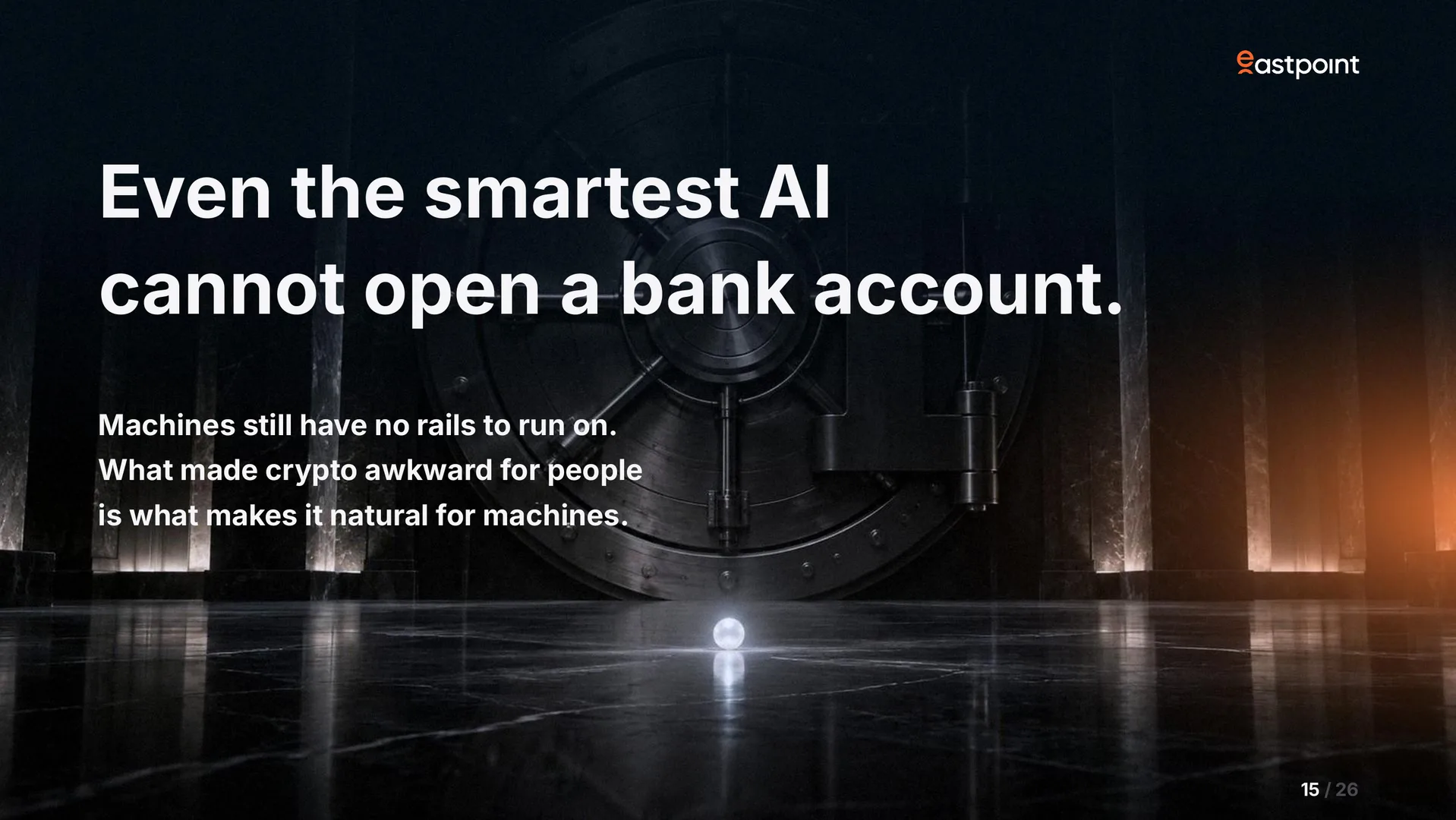
There's one picture that shows how much trust is missing. Even the smartest AI can't open a bank account. It can't buy a five-dollar-a-month server on its own. Accounts, signatures, and bank counters were all designed with a person in mind. Crypto, which proves ownership with a single key, was always a bit awkward for people, but it's a grammar that fit machines from the start. Maybe crypto's first real users were never people at all.
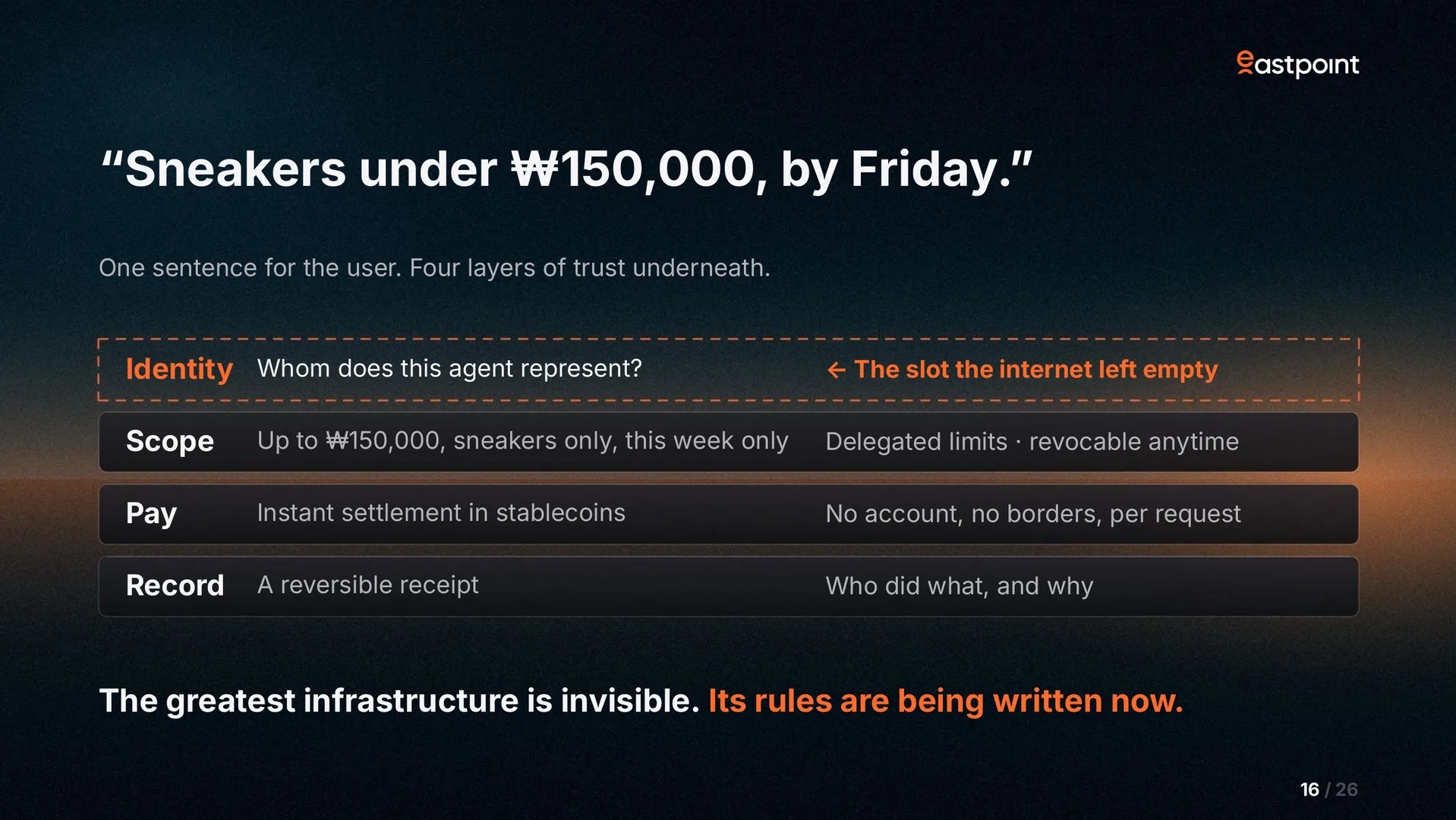
Imagine saying this: 'Find me sneakers under 150,000 won that arrive by Friday.' That one sentence is all the user sees. Underneath it, four layers build trust: identity, which shows whom the agent represents; permission, the limit you've given it; payment that settles right away; and records that can be undone. Many companies are already building payments, but the question 'whose side is this agent on?' still has no owner. I think identity, the first box the internet left empty for thirty years, is the biggest opportunity.
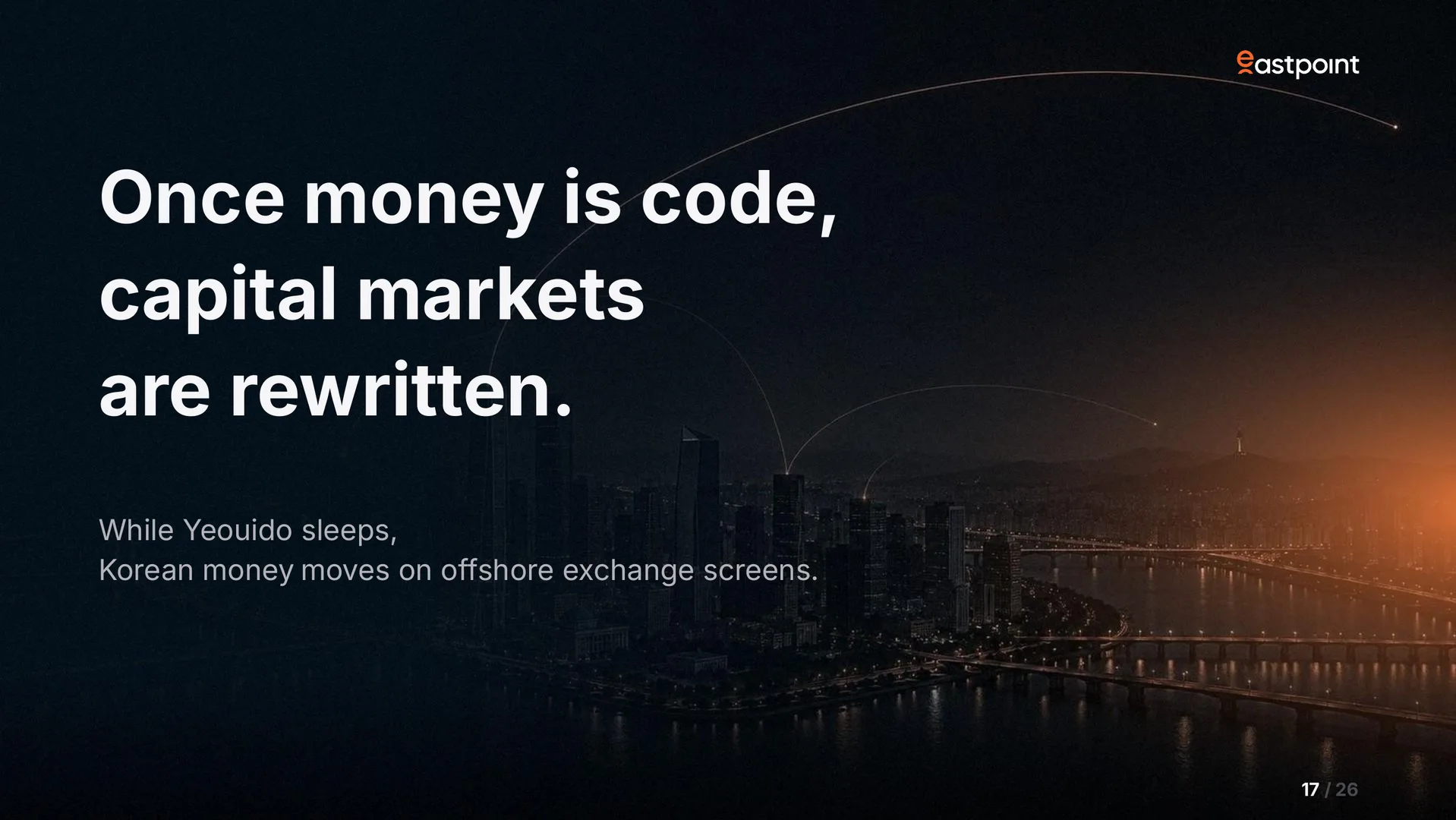
When money becomes code, capital markets get rewritten too. Even at dawn, while Yeouido is asleep, Korean money is moving on the screens of overseas exchanges. The market has already left the building. The towers of Yeouido were a symbol of trust for a long time. As trust moves into code, the market's address moves from buildings to rails. Capital doesn't stop moving while our doors are closed. It just moves onto another country's rails.
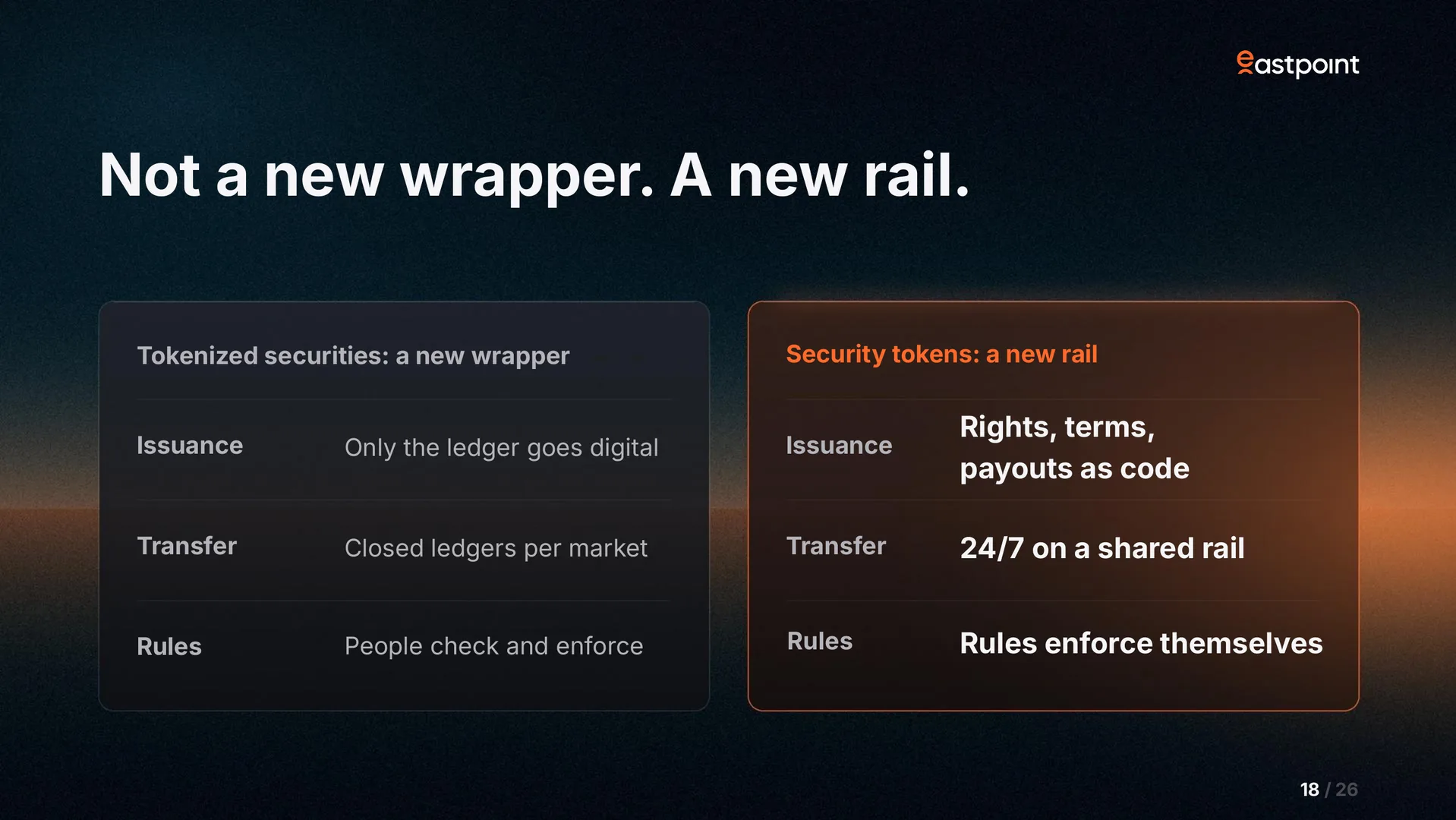
That's why I think word order matters here. Not tokenized securities, but security tokens. Tokenized securities just move the ledger to digital; each market stays closed off, and people still check the rules by hand. Security tokens carry rights, conditions, and dividends in code, and move around the clock on shared rails. Scanning paper didn't create the internet, and moving a ledger won't change a market. Institutional money will come in with confidence once these rails are in place.
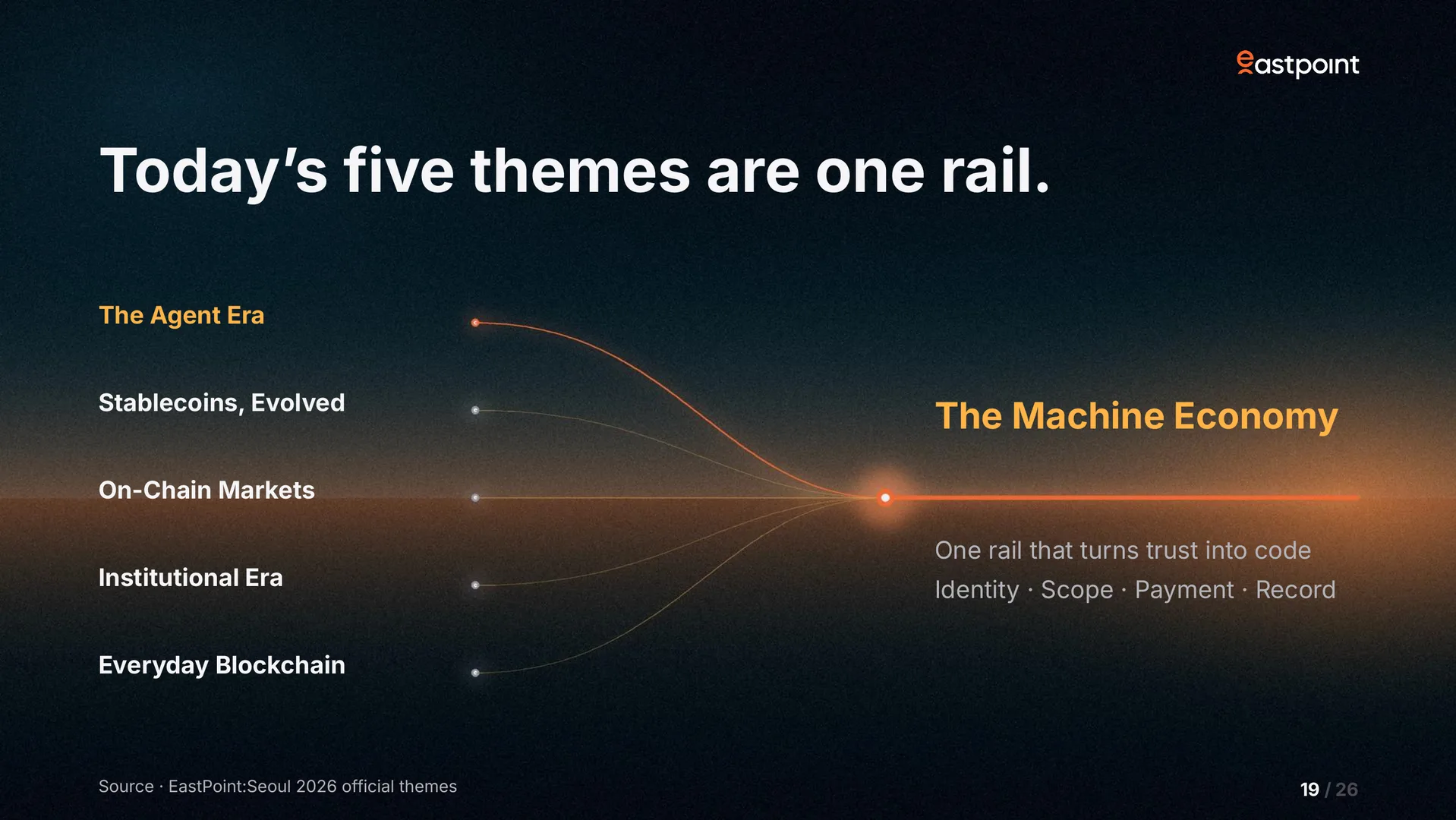
Let's look at today's five themes once more: AI agents, stablecoins, capital markets on-chain, institutional investment, and everyday blockchain. To me, they're less separate industries than different answers to the same question: how do we build trust in transactions where no person is present? Together, the five themes are one rail for an economy where machines do the work. So doing just one well probably won't be enough. Whoever connects all five will shape the game.
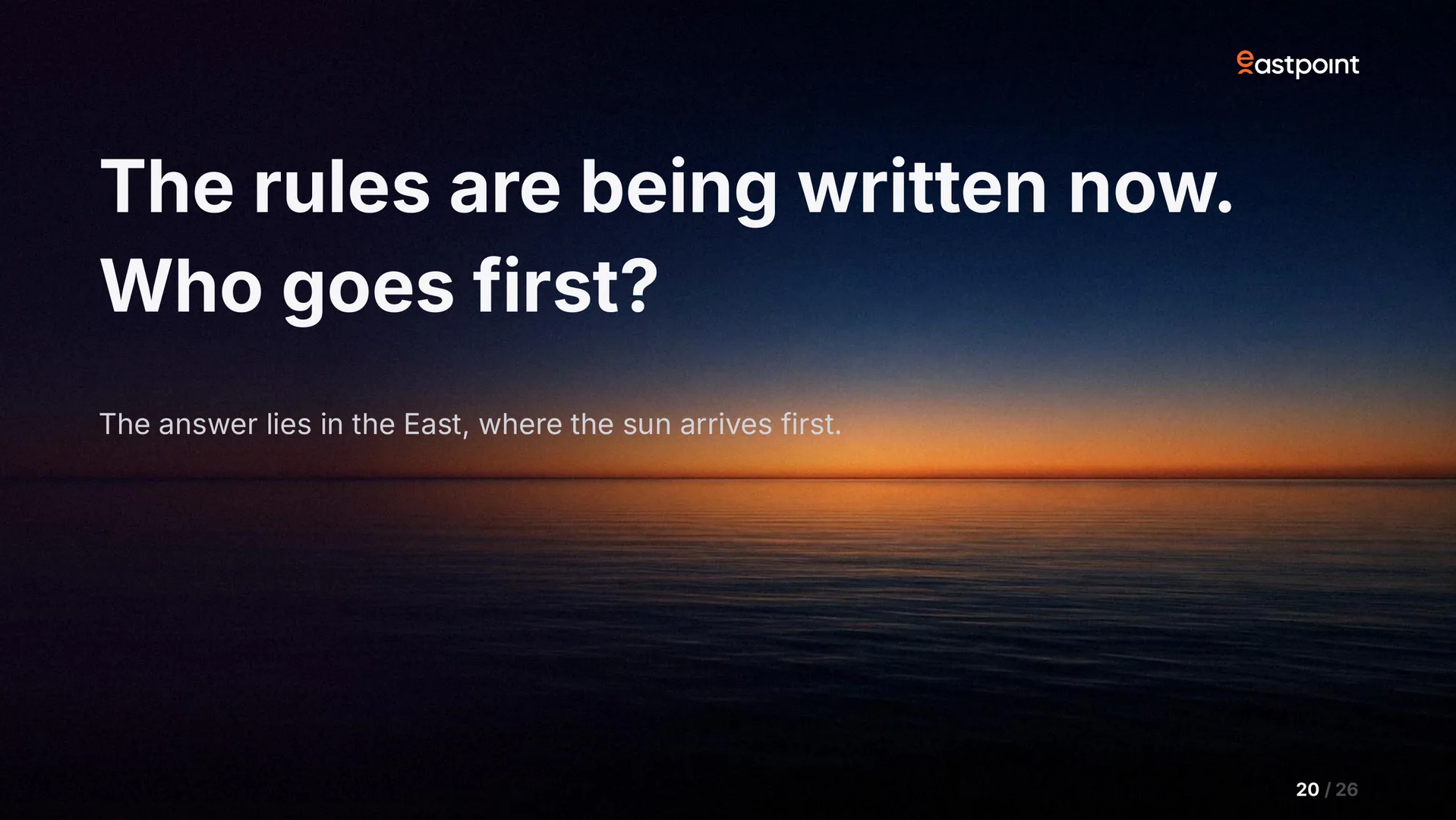
So one question remains. If the rules for these rails are being written right now, who will try first? Rules have always come from the experience of the people who tried first. From here, as someone who helped put this gathering together, I'd like to speak to you directly. I believe the answer lies in the East, where the sun arrives first.
I think the place to try first is Korea. In its catch-up years, Korea was the country that found the right answer fastest. We reduced errors through approval chains and did only what was permitted. But in an age with no set answers, the speed of being wrong becomes national strength. The hardest thing to let go of is a system that worked extremely well. The reasons for a regulation get written down, but the companies that were never born aren't recorded anywhere. Korea hasn't lost its skill. The rules of the game Korea was good at have changed.
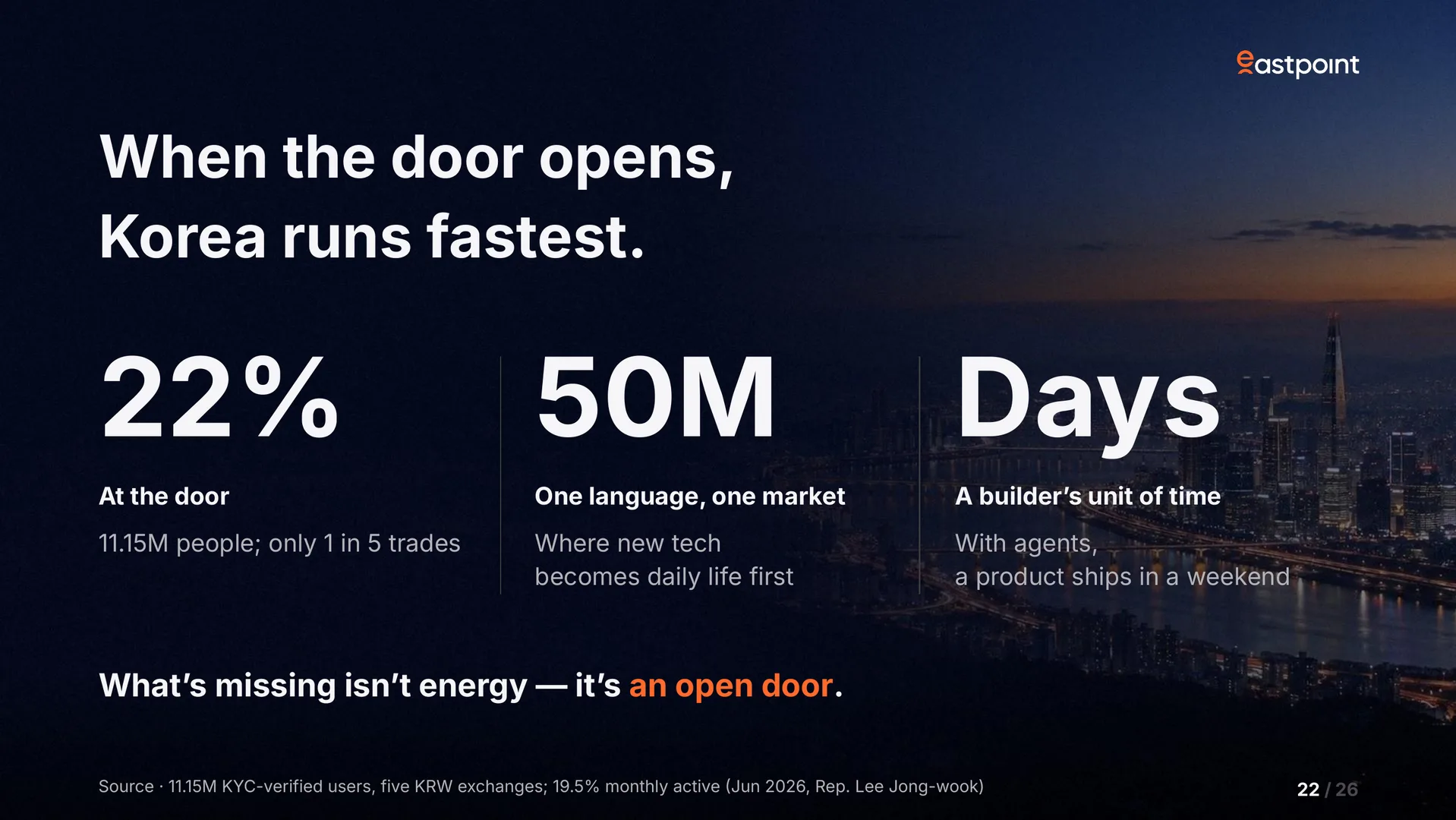
Fortunately, Korea has energy. 11.15 million people have completed identity verification on won-based exchanges. That's 22% of the population. But only about one in five of them trades even once a month. People have come right up to the door, but there's nothing to do inside, so the money goes abroad. What's missing isn't energy, but an open door. And I think that gap is exactly the size of Korea's opportunity.
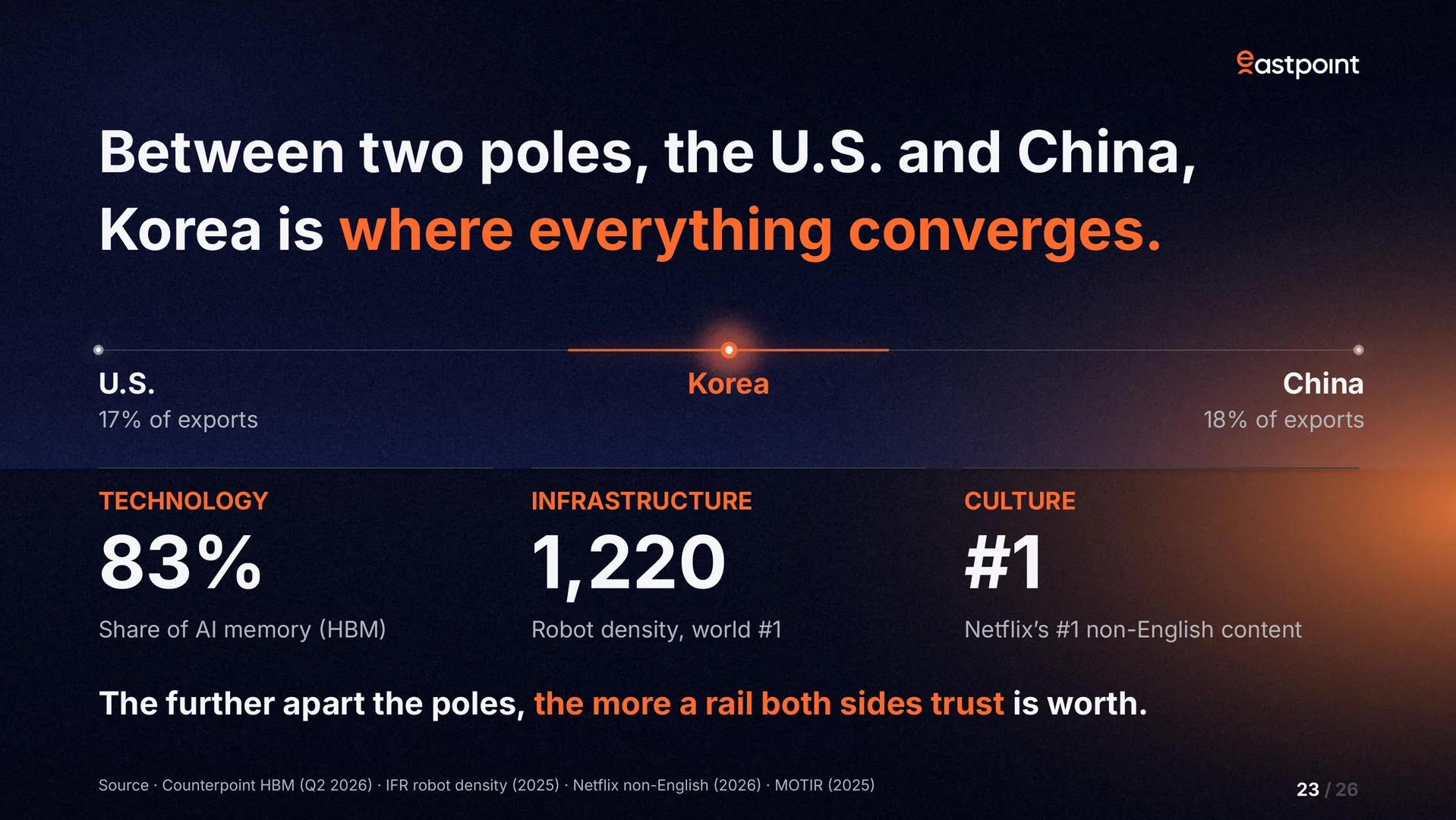
And it's not only energy. Korea also has a position. 17% of Korea's exports go to the United States and 18% to China, nearly equal weight on both sides. At the same time, 83% of the world's AI memory, the highest robot density in the world, and Netflix's top non-English content all come from one country. Korea is less caught between two poles than a place where they meet. The more the world splits in two, the more valuable a rail both sides can trust will become.
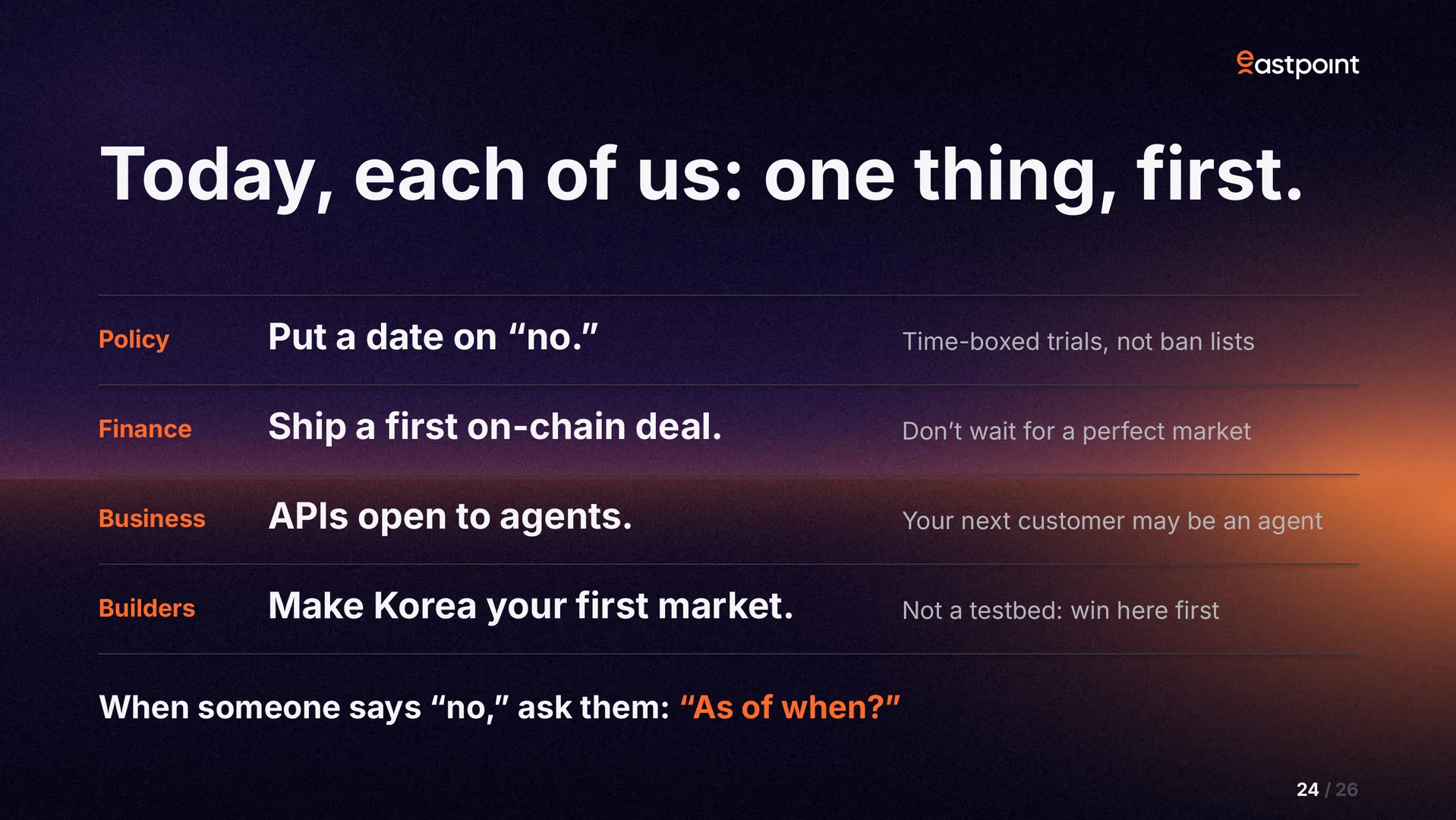
So I'd like to ask you a small favor. Today, could each of us do just one thing first? To those who make policy, I'd ask you to put a date on 'no.' For finance, the first on-chain product and the first stablecoin settlement. For companies, APIs that are open to agents. And for builders, making Korea your first market. This isn't about changing the whole world. It's about each of us taking one step ahead. And when someone says 'no,' please just ask them once: until when?
If each of those steps comes together, a small dot in the East could become a starting point for the world. If, ten years from now, the world's agents get their first identity and make their first payment in Seoul, Korea could become a country that helps write the rules rather than just follow them. The rules of the internet were written in Silicon Valley, but where the rules for agents will be written hasn't been decided yet. That's why Hashed wanted to create this gathering. I'd love for us to begin writing the next decade's rules together, here in this room, today.
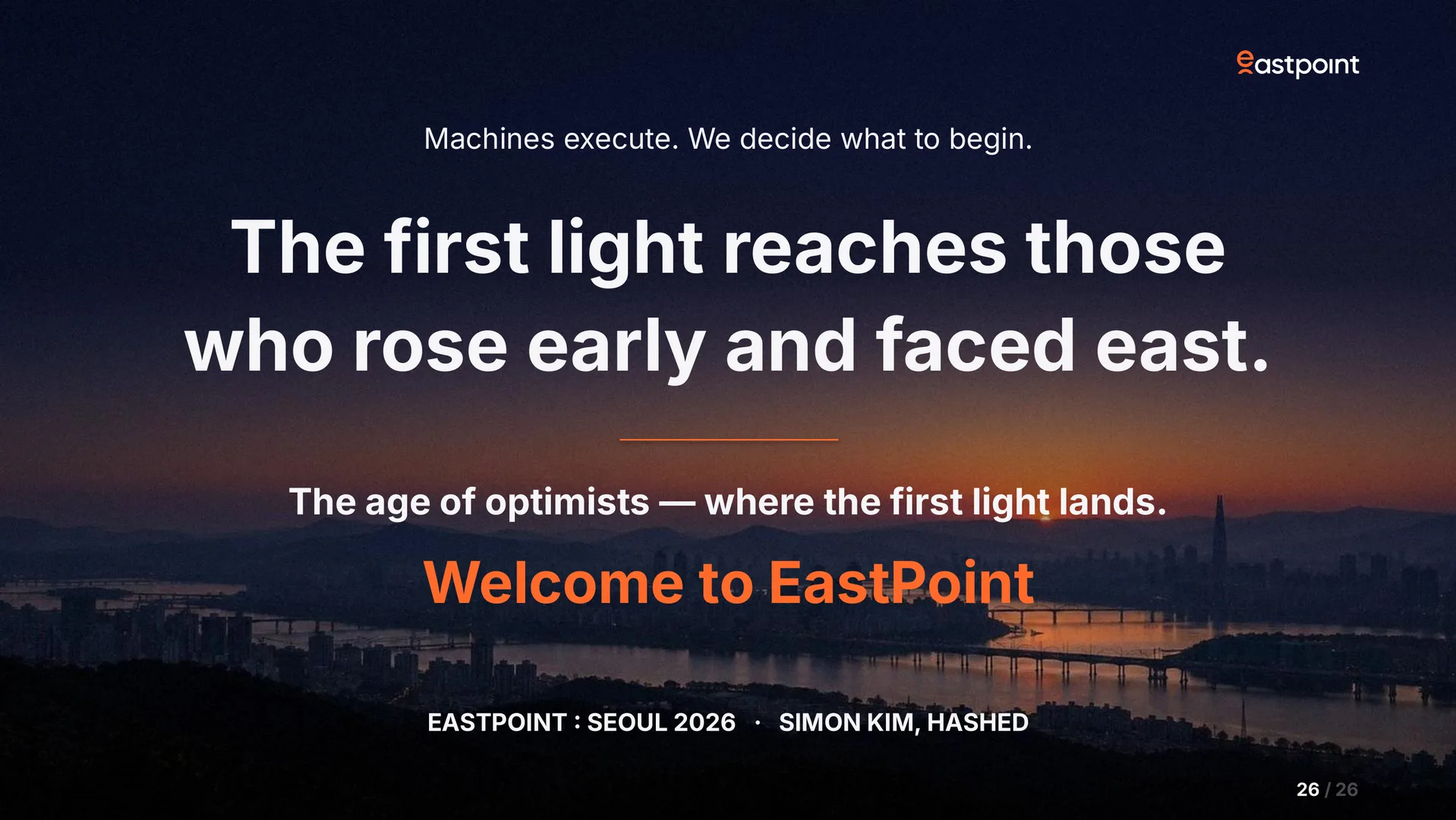
Machines now do the executing. But what to start is still up to us. This morning in Seoul, the sun rose at 6:24. The sun rises in the East every day, but the first light reaches the people who got up early and looked east. In a world where machines can do so much, one of the biggest jobs left to people is to start first. In an age when being wrong is cheap, optimism is the most rational strategy. The age of optimists, where that first light lands. Welcome to EastPoint. Thank you.